Thomas disappears from Hope House and drowns
I Know This Much Is TrueThomas disappears from Hope House and drowns in the hours after Dominick leaves him there, turning a routine overnight admission into a death that cannot be fully explained. The search moves from institutional procedure to family guilt and finally to the river, where Thomas’s body is found. The coroner calls the drowning accidental, but the evidence does not establish whether Thomas entered the water by choice or by mischance.
Admission to Hope House
Dominick makes supper for Thomas, then drives him to Hope House and checks him in. During admission, the nighttime supervisor reads aloud the belongings Thomas has brought: shoes, a Bible, and two other religious books. Thomas appears oblivious to the process around him, absorbed in his old favorite, Lives of the Martyred Saints. The contrast is stark: the staff inventory his possessions and complete his admission while he remains with a book that belongs to his familiar religious world.
Dominick leaves Thomas in the recreation room, slumped in a stuffed chair and watching television. Above him, a banner announces, “Hope Springs Eternal at HOPE HOUSE!” The optimistic slogan hangs over a scene of separation that Dominick does not yet understand as final. He says, “See you tomorrow,” bends down, and kisses the top of Thomas’s head. At home, he drinks about half a beer before dozing off and sleeping heavily. The ordinary farewell and the unremarkable details of the evening sharpen the abruptness of what follows.
The missing-person search
A telephone call wakes Dominick. The woman on the phone says Thomas is missing, and reports that he must have left sometime after the last bed check, conducted shortly after 2:00 a.m. The police are on their way. Dominick calls Ray, who is already awake, then picks him up before they go to Hope House. The director repeatedly raises her hands and attributes the disappearance to underfunding, saying that such incidents did not happen before the cutbacks. Her explanation places the search against the institution’s stated resource problems, but it offers no account of where Thomas went.
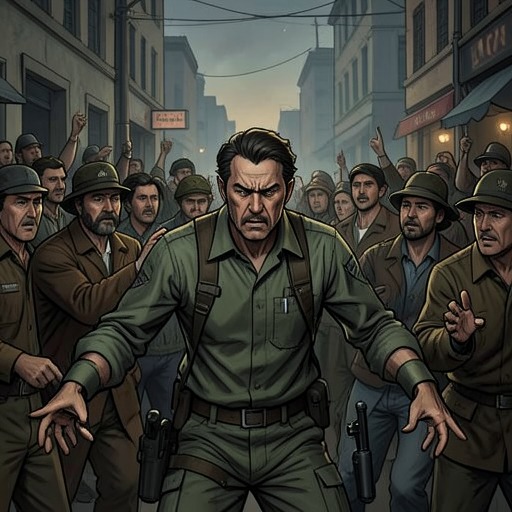
Officer Jerry Martineau arrives, and Dominick and Ray give the police places where Thomas might have hidden in the past when paranoia closed in on him. Martineau tries to reassure them: Thomas has been missing only a short time, daylight is approaching, and more officers can be called in by midmorning if needed. Dominick accepts the offered optimism outwardly, but inwardly he already believes Thomas is dead. He describes that certainty as a dead weight he has carried since getting out of bed after the call, as if part of himself had died with his brother before the body was found.
Dominick chooses to search at the Falls. He and Ray park at the Indian graveyard and follow the path toward the river. They call Thomas’s name repeatedly into the thundering water and the fog hovering above it. The landscape offers no answer, and the search remains a family act as much as a police matter: the brothers are calling into a place where Thomas has hidden before, while Dominick already fears that this time he cannot be found alive.
Recovery and identification
On the walk back to the car, Ray breaks down over his treatment of Thomas as a child. He admits that he rode Thomas too hard and says he had been trying to toughen him for the world, while also blaming Ma for being overly protective. His account brings an earlier family conflict into the present search: the effort to explain Thomas’s vulnerability through competing ideas of discipline and protection cannot undo what has happened. Ray gets out of the car and circles it, repeating his distress, while Dominick is left with the confession and the still-unresolved search.
The rescue squad finds Thomas’s shoes and socks on the bank a couple of hundred yards beyond the waterspill. A little before noon, two rescuers find his body in waist-deep water, caught in the branches of a fallen tree. They estimate that he has floated about half a mile downstream. Rocks have battered him, and the tree has left scratches across his face. Ray goes down to identify the body; the current, still wild after the rain, rushes around and over Thomas. The search’s successive discoveries—the abandoned footwear, then the body—make the river’s violence concrete without explaining how Thomas entered it.
The unresolved death
The coroner later estimates that Thomas drowned at about 4:00 a.m., close to the time Dominick’s phone rang. The timing aligns the official account of the death with the moment Dominick was awakened and began to fear the worst. The ruling is accidental, despite Thomas’s shoes and socks having been left on the bank. Whether he jumped or fell into the water remains beyond what the family can establish.
That uncertainty is central to the event’s ending. Thomas is no longer missing, and Ray has identified his body, but recovery does not bring an explanation or settle the question of intention. The river supplies physical evidence—distance, current, rocks, branches, and injury—while withholding the decisive fact. Dominick’s foreboding precedes the discovery, but it is not knowledge of how Thomas died; the official ruling, too, stops short of certainty. What remains is a death confirmed, a family confronting its past, and a brother left with an answer about where Thomas ended up but not how he got there.